Publication Ethics
Ethical Guidelines for Journal Publication
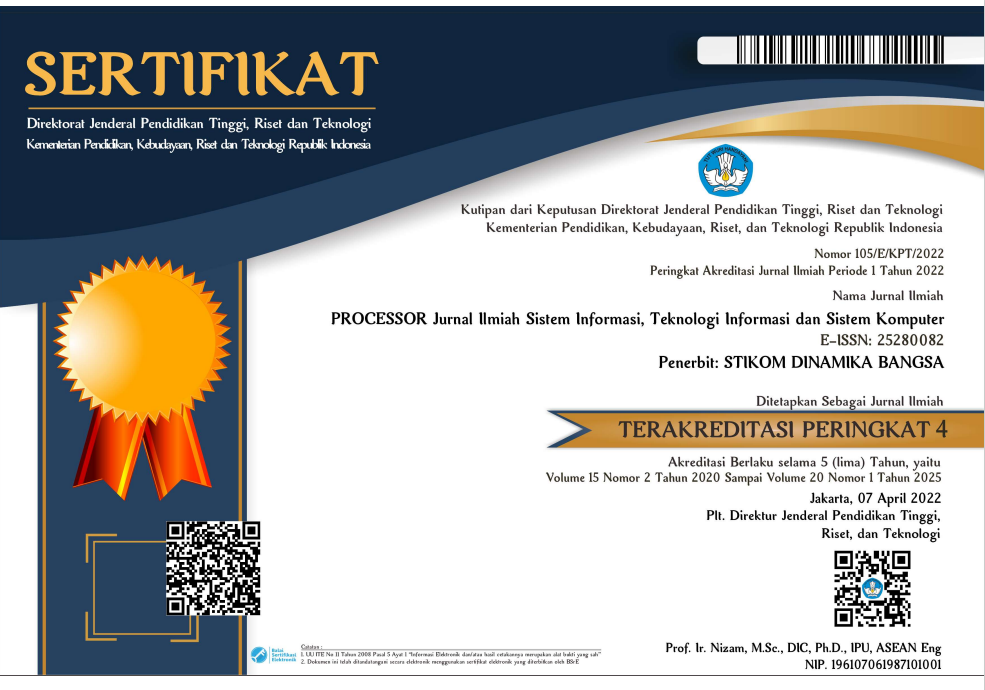
The publication of scientific articles through the PROCESSOR journal is a tool used by academics to develop related knowledge. Therefore, the peer-review process involves the principles of the scientific method. Therefore, ethical guidelines are required for all parties involved in publishing articles through this journal, including authors, journal editors, reviewers, publishers, and the public.
Duties of Publisher and Editor
LPPM STIKOM Dinamika Bangsa Jambi, as the publisher of PROCESSOR, strictly oversees all stages of publication, and we understand each function, ethics, and other responsibilities that fall under our purview.
Publication Decisions: The PROCESSOR editor is responsible for deciding whether each article submitted to the journal is suitable and meets the criteria for publication. Validation of research activities and their contributions to researchers and readers must always result in a decision. The editor is also responsible for addressing issues related to copyright infringement and plagiarism. The editor may consult with other editors or reviewers in making this decision. Fair play: Editors evaluate each manuscript for its intellectual content without regard to race, gender, religious belief, ethnicity, citizenship, or political philosophy of the authors.
Confidentiality: The editor and any editorial staff do not disclose any information regarding a submitted manuscript to anyone other than the corresponding author, reviewers, other appropriate editorial advisers, and the publisher, as appropriate.
Disclosure and conflicts of interest: Unpublished materials disclosed in a submitted manuscript must not be used in the editor's own research without the express written consent of the author.
Duties of Reviewers
Contribution to Editorial Decisions: Peer review provides recommendations and assists the editor in making editorial decisions and, through the editorial communications with the author, may also assist the author in improving the manuscript.
Promptness: Any designated reviewer who feels unmet criteria to review the research or finds it impossible to complete the review process in a timely manner should notify the editor and excuse himself from the review process.
Confidentiality: Any manuscript reviewed is confidential. They must not present or discuss the work with others unless authorized by the editor.
Standards of Objectivity: Reviews should be conducted objectively. Personal criticism of the author is inappropriate. Reviewers should express opinions clearly with supporting arguments.
Acknowledgement of Sources: Reviewers should identify relevant published work that has not been cited by the authors. Any statement that an observation, description, or argument had been previously reported should be accompanied by the relevant citation. A reviewer should also alert the editor to any substantial similarity or overlap between the works presented and the research.
Reporting Standards: Authors of manuscripts should present an accurate account of the work performed and should present a purpose and significance. Referenced data used should be represented accurately in the manuscript. Each manuscript should provide sufficient detail and references to permit others to replicate the work. Fraudulent or knowingly inaccurate representations constitute unethical behavior and are unacceptable.
Data Access and Retention: Authors are required to provide the raw data relevant to their manuscripts for editorial review. Originality and Plagiarism: Each author should ensure that they have entirely original work and/or written material, and if the authors have used the work and/or words of others, that this has been appropriately cited or quoted.
Multiple, Redundant, or Concurrent Publication: An author should not publish essentially the same research in more than one journal. Submitting the same manuscript to more than one journal concurrently constitutes unethical publishing behavior and is unacceptable.
Acknowledgement of Sources: Acknowledgement of the work of others must always be given. Authors should cite publications that have been influential in the reported research.
Authorship of the Paper: Authorship should be limited to those who have made a significant contribution to the conception, design, execution, or interpretation of the reported research. All those who have made significant contributions should be listed as co-authors. Any others who have participated in certain substantive aspects of the research project should be acknowledged or listed as contributors. The author should ensure that all co-authors are appropriately acknowledged.